
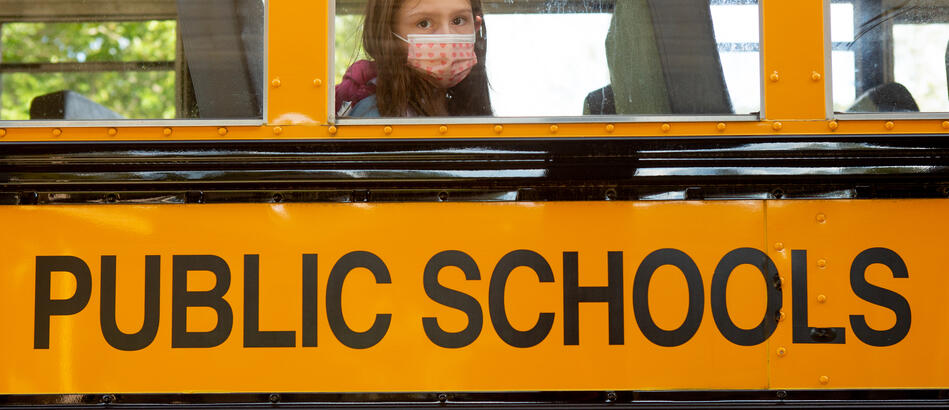
It amazes me how quickly we seem to forget that in March 2020 we experienced the beginning of a global pandemic. The K-12 education systems throughout the country closed and then moved to remote learning.
And thus began our journey learning how to operate a public K-12 education system in the context of the COVID-19 pandemic.
I mean, we remember it. But sometimes when we are looking at research findings or data pre-, during and post-pandemic, I rarely see a notation on the extent of pandemic effects that go beyond an interruption to assessments in 2020. If there is one thing I know from my decades as an education policy researcher, it is that context matters.
Anyone who has tried to scale an intervention or just implement a strategy that worked in one place knows that there is a degree of adaptation based on the strengths, weaknesses and specific nuances of an individual school, district, and community.
Context matters. And it is the reason the RESTART Network developed a set of resources and tools to support researchers in taking into account some of the bigger picture contextual factors brought on by the COVID-19 pandemic. These resources will support the research and policy community in understanding the context considerations as we examine K-12 education data, indicators and trajectory before, during and through the ongoing pandemic recovery.
Resources
Voices from the field: K-12 education system lessons from the COVID-19 pandemic
At the RESTART National Network Forum in May 2025, participants discussed how schools responded after the onset of the COVID-19 pandemic and throughout each disruption recovery stage. Participants’ reflections from that time and insights for action are captured in this report.
The practitioners, policymakers, and researchers at the forum reflected a range of perspectives and experiences. Learn more about the best practices, crisis learnings, questions for the future, and areas for improvement identified by these experts.
Preparing for educational disruptions
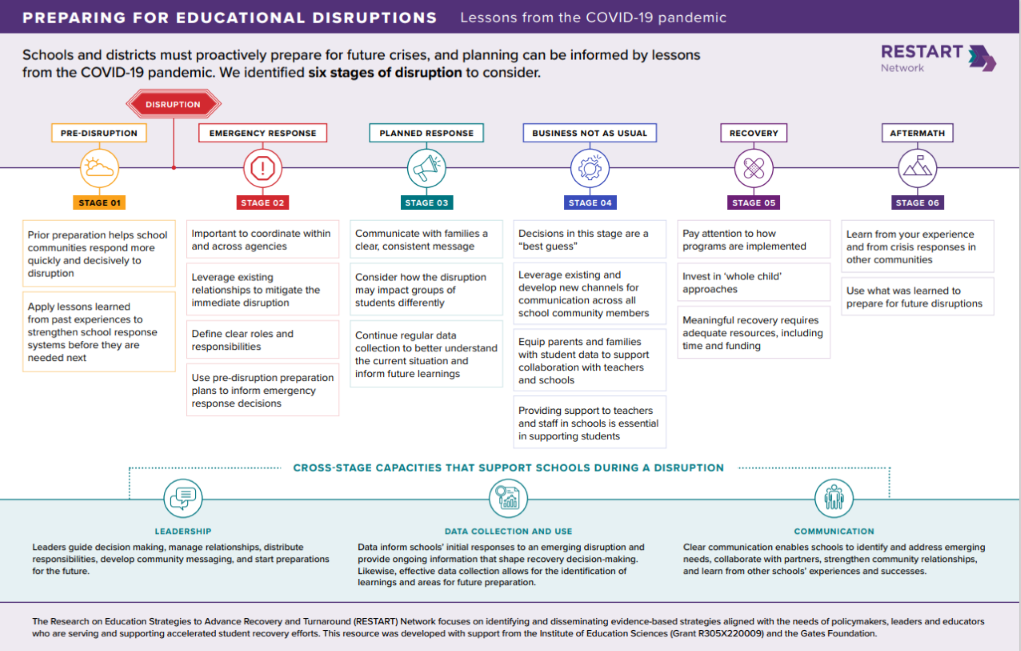
Pre-disruption preparation helps communities respond quickly and decisively. The next stage involves emergency response that must involve cross-agency coordination. The following stages of planned response and business not-as-usual require consistent communications and data utilization. Moving towards the recovery and aftermath stages, schools must pay attention to and study how implementation worked for them. This infographic categorizes best practices for each stage of recovery following an educational disruption.
The infographic also spotlights three capacities that are central to a school’s response to a disruption: leadership, communication, and data collection and use.
Take a look at the stages of disruption and essential considerations for each.
COVID-19 pandemic timeline and U.S. education: How did school systems and students experience the COVID-19 pandemic?
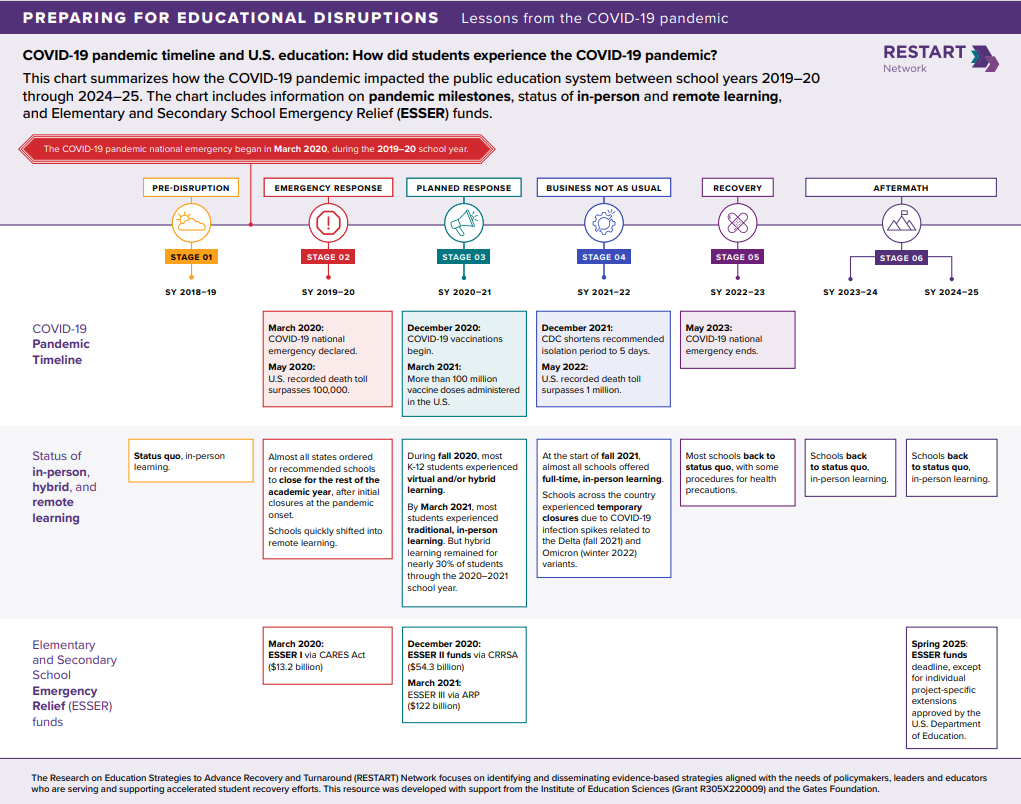
Five years from the outset of the COVID-19 pandemic, we can now look backwards to better understand how school systems and students experienced the educational disruption. This resource includes information on pandemic milestones, status of in-person and remote learning, and Elementary and Secondary School Emergency Relief (ESSER) funds. The infographic also documents changes in public K-12 enrollment, chronic absenteeism rates, and National Assessment of Educational Progress (NAEP) performance.
Check out this reference infographic regarding the COVID-19 pandemic timeline and data trends.
Where are they now? Following student cohorts
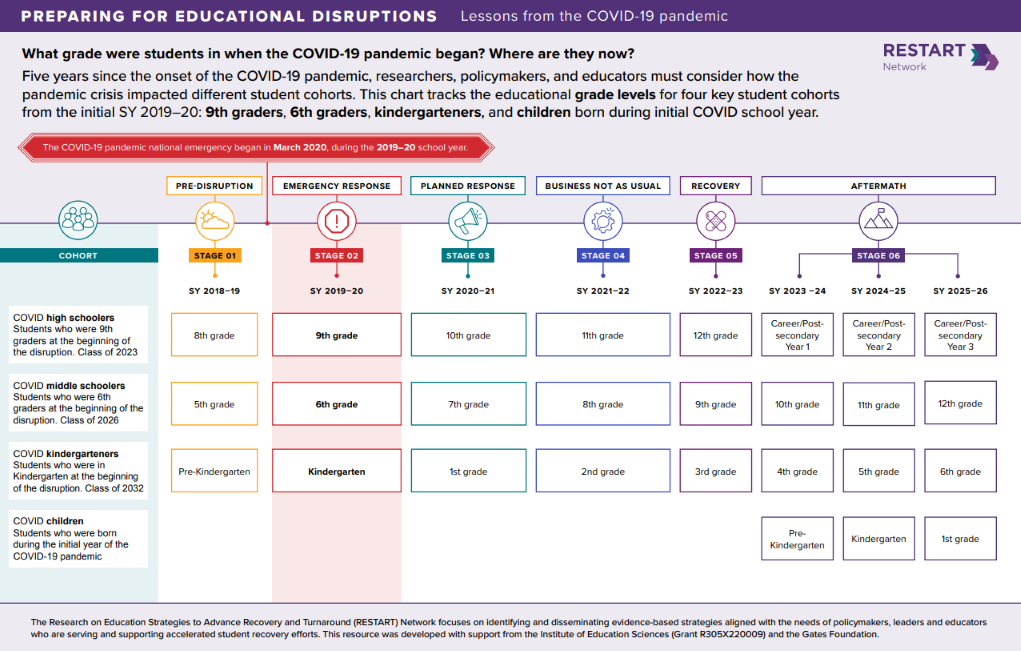
While all K-12 students were impacted by the onset of the COVID-19 pandemic, not all students experienced the disruption at the same time in their educational careers. This infographic documents the educational progression of four key student cohorts from the 2019-20 school year: 9th graders, 6th graders, kindergartners, and children born during the initial COVID-19 school year.
For example, students in kindergarten during the onset of the pandemic were the same students participating in the 2024 NAEP 4th grade assessments. In this cohort, 69 percent of students were below proficiency on the NAEP fourth grade reading assessment. We know learning to read by the end of third grade is a critical developmental milestone, and interrupted instruction or missing in-person instruction during one of the years of school (kindergarten and possibly first grade, depending on the state) may impede achievement of this milestone.
It is important to follow these cohorts of students, because recovery will be ongoing for them. That is why we developed a quick reference document that helps contextualize cohorts’ COVID-19 disruption education experience.
The infographic helps us understand how students have continued to be affected by the COVID-19 pandemic over time.
Susan Bowles Therriault is the principal investigator of the RESTART Network and an Institute Fellow at AIR. For over 20 years, she has led and conducted research that focuses on state and federal education efforts to build the capacity of high-needs districts and schools to improve outcomes and increase opportunity for students.
Photo by Allison Shelley for EDUimages